


Are private hearing aids better than NHS ones?
Anyone just beginning to realise that they need a hearing aid tends to look at privately bought ones before NHS* ones because it is generally thought that the private ones look more attractive. So I'll consider appearances first and then go on to costs, waiting times and general usefulness.
Appearances of hearing aids
 |
 |
 |
|
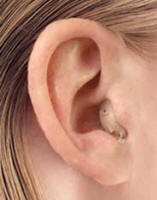
Left: An in-the-ear aid. |
||
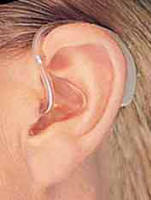
A quick search on 'hearing aids' on Google Images shows the huge range available. The most common are either 'in the ear' or 'behind the ear', but they come in a range of colours and designs, some with the electronics hidden in spectacle frames and some so small as to be almost unnoticeable to the casual observer.
If your hearing loss is mild and your bank balance healthy, you may want to go to a private supplier for one of the more elegant hearing aids or even the so-called 'invisible' ones, which are tiny 'in the ear' ones. My own view, which is of course highly personal, is that 'in the ear' hearing aids can look dirty at first glance because all the controls and battery doors show as dark shadows. Also the very tiny ones are unsuitable for substantial hearing loss.
If you go for a private hearing aid, beware that you may get sold an aid that is not best suited for your type of hearing loss. In my experience, most people with only a mild hearing loss prefer to rely on the sorts of coping strategies elsewhere on this website, rather than on hearing aids.
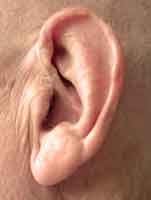
NHS hearing aids aim - first and foremost - to help people hear better, within of course certain cost constraints. Their design range is minimal, although little different from many of the private aids that people seem to wear in real life outside the fashion catalogues. For less severe hearing loss, the NHS can supply a small earpiece with such a fine tube that it just looks to the casual observer like a hair out of place - see the right-hand photo above. My own hearing loss is too severe to take advantage of this.
Features of hearing aids
In my view, far and away the most worthwhile feature of hearing aids over and above being able to hear better is the facility to use a loop system. All NHS hearing aids incorporate this feature or can do if requested. (They are often not turned on in the first instace to limit the confusion of controls for new users.) Private hearing aid suppliers can also supply a number of additional features which may or may not be worthwhile for everyone. The best shop window for them is the internet.
NHS hearing aids have improved dramatically even since I have been maintaining this website - see the Phonak S+ M NHS hearing aid on another page
Personal experiences
Over many years, I have had appointments with a number of private hearing aid suppliers and have also been seen at NHS hospitals. This resulted in my being given 'in the ear' aids by the private consultants and 'behind the ear' ones by the NHS. I gave up with them all because I just couldn't get on with them - hence all the coping strategies elsewhere on this website. Later I tried again - with private suppliers and with the NHS. This time, with digital aids, the differences with the NHS were so dramatic that it is worth reporting on my experiences.
After the normal tests, one private supplier said - almost certainly correctly - that a tiny 'in the ear' aid was impossible for me because my type of hearing loss required too much electronics. An 'in the ear' aid could be supplied, but it would stick out rather a long way. The other private supplier took my money for a black - yes black! - 'behind the ear' aid as "best" for my type of hearing loss although it gave me major problems. The NHS supplied me with a free aid that looked identical except that it was silver and did improve my hearing! In my view the silver one looked the more attractive anyway.
I wouldn't want to damn all private suppliers, although my years of experience with them has not been good. However, an experience with a friend at a Boots hearing aid appointment was extremely positive, apart of course from the associated costs.
Costs
Costs can be summarised as Private=very expensive and NHS=free. In addition, the batteries for private hearing aids are an on-going expense whereas NHS ones are free and available at various fairly local outlets so that repeated visits to hospital are unnecessary. Initial follow-up appointments - which are invariably inevitable for best results - cost, or are included in the cost, with private suppliers and are free with the NHS.
My latest experience with a private hearing aid would have cost around £2000 per aid, ie £4000 for one in each ear, and I was encouraged to pay even more for what was called 'more channels'. No-one had ever mentioned 'channels' in connection with the free NHS aids, although I have since discovered that they too are multi-channelled.
Fortunately I was allowed to try the private aids for a month on a sale-and-return basis. I returned them as useless. Of course my hearing problems are unusual and other people may have satisfactory experiences with private hearing aids. I would have had more respect for the private audiologist, though, if he had said - or possibly even have known - that his range would not be able to help me. The NHS audiologist told me that I needed what was known as a 'vent' earpiece. The private audiologist never mentioned this and certainly didn't supply it in his trial version. He was from a well-known national company.
Half-price hearing aids and special hearing aids for pensioners
From time to time, there are adverts for half-price and discounted hearing aids. Be tempted if you like, but half of something expensive is still a waste of money if what it buys is useless. Normally they are old stock which is being replaced by more up-to-date technology. However, your experience may be more fortunate than mine.
Hearing aids for pensioners are also advertised, which are presumably either supposed to be discounted or imply that 'one-size-fits-all' or are a tempter for more expensive 'better' aids. You can imagine my views on them.
Waiting times
I waited seven weeks between the referral from my GP and seeing the NHS audiologist at the local hospital. The hearing test took place on the same day. Then I waited another six weeks for the aids to arrive and be fitted. Further appointments for adjustments were provided quite quickly. The private dispenser, on the other hand, saw me almost immediately, and the aids - useless as they were - came within a couple of weeks.
Usefulness
All this said, appearance, delays and costs are not major considerations for most people with hearing loss. They would sacrifice a lot to own a hearing aid that would genuinely help. That really is the crux of the matter.
Over the years I have wasted a great deal of money on private hearing aids. I mustn't castigate all private hearing aid suppliers as there must be some excellent ones out there. Maybe it all depends on how much one is prepared to pay and how good the various audiologists are at their jobs. I have also had free NHS hearing aids over the years and they did not work for me either.
However things changed after my doctor (GP) told me that it was "different now with the digital age" - and she was right. I was seen by expert medical consultants who were polite and knowledgeable and who had time for me. I had to go back several times for various adjustments and further tests because my hearing loss is not straightforward. These appointments were with NHS audiologists who were equally polite, knowledgeable and helpful. I was never made to feel a nuisance.
Conclusions
It must be obvious by now that my personal experience has led me firmly in the direction of NHS hearing aids - particularly the latest NHS hearing aids - rather than private ones. I can take part in most conversations, and interaction with other people has become possible and enjoyable.
More on getting the best use from hearing aids
Would I use a hearing aid if I had one?
Are private hearing aids better than NHS ones?
Are two hearing aids better than one?
Not 'getting on' with hearing aids.
My hearing aids hurt: everything is too loud and distorted.
My hearing aids hurt: the pressure seems to bruise my ears.
My hearing aid whistles.
'Try before you buy' hearing aids.
The importance of the hearing test.
Why might my NHS hearing aids be better than my experiences of private ones? Certainly the technology has improved dramatically in recent years, but the NHS also seems to have superior equipment for testing and programming the aids and it seems to have better trained audiologists as well as direct access to specialist doctors. Of course there may be - in fact there must be - private suppliers out there who can match the NHS in these areas. I can only say that, over decades of trying to find solutions to my own hearing problems, I have not found any of them. As I have already said, though, experience with a friend was much more positive - see my page on try before you buy hearing aids.
__
* The NHS is the UK's National Health Service which is free at the point of delivery.
Disclaimer: The information on this site is for a lay audience and I cannot be responsible for errors or omissions. The views, strategies, advice and suggestions etc are based on my personal experience and are not necessarily appropriate for anyone else. They should, hopefully, stimulate individuals to develop their own strategies.