


The 'latest' NHS hearing aids: a review of experiences and conclusions
Calling a hearing aid the 'latest' does of course mean that at some time in the future it will no longer be the latest. So let me be clear at the outset that I am speaking about the hearing aid that an NHS* hospital audiologist prescribed to me in 2019 as one that was being 'trialled' there. Since then, as I write in 2020, it seems to be being offered to all its patients and I am told by not necessarily reliable sources that it or something similar has become standard in all NHS audiology centres.
This review is personal. It relates to my own experience of the hearing aid and that of another member of my family.
The Phonak Nathos S+ M hearing aid
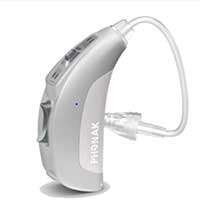
The Phonak S+ M hearing aid showing a small mould. It is also suitable for a full size mould and wider tube.
The 'latest' NHS hearing aid seems to be manufactured solely for the NHS in that I have not been able to find it available anywhere else, even for purchase. It is the Phonak Nathos S+ M or just the Phonik S+ M. and is shown in the photo. It is a 'behind the ear' aid and although the photo shows a small mould and narrow tube, which is what my family member has, it also takes a normal sized mould and thicker tube which is what I have to have for my more severe hearing loss.
Advantages of the Phonek S+ M over the earlier standard NHS model
I have quizzed audiologists on what technical advantages this newer model provides, but without much agreement. Individuals have said that:
- There are more channels in the speech frequencies which lead to clearer speech
- The software limits the loudness of sudden noises such as bangs and crashes while maintaining the loudness of speech
- In addition to the general purpose programme which is in operation when the aids are turned on, there are three more options:
- loop only
- loop plus microphone (to hear what people around are saying while using the loop)
- and the choice of either for music or for cutting down background noise with the microphone set on directional. I chose the latter.
- Less whistling
The internet does list the features of the Phonak S+ M but not, to my mind, in a user-friendly way. It leaves me no wiser about why anyone would go to much trouble to update to the Phonak S+ M. Neither does the internet list the cost of the Phonak S+ M which is hardly surprising since it is manufactured solely for the NHS. I do wish, though, that the internet would indicate how much one would have to pay privately for something similar.
My experience with the Phonak S+ M
My hearing loss is severe, but I had been just about managing with my old hearing aids. So I was reluctant to accept the call from the NHS for a new hearing test. However, I went along for it. The first visit was no different from previous hearing tests, but the second visit was. The new hearing aids were waiting, ready programmed according to the hearing test, but there was a new additional test or programme refinement. This consisted of some sort of gadget being placed over my shoulders and various sounds being played into my ears. This time I did not have to say anything about them. Everything was software controlled. Once this was over, I was presented with the hearing aids and spare batteries, and listed for a follow up in what I think was ten weeks.
I begged to keep my old hearing aids in case I couldn't get on with the new ones and this was reluctantly agreed, provided that I returned them on my follow-up visit as they had to be recyled.
Yet, I have never used my old hearing aids again! Wearing my new ones, I walked out of the hospital into a busy street and heard sounds that I had could hardly remember ever hearing before!
I am happy with the additional channels and although I note from the internet that private and expensive hearing aids have more, I can't see that they would help me particularly.
The Phonak S+ M runs on batteries that are of course free on th NHS. Some private aids have rechargable batteries that need to be placed in a recharging unit overnight. That may suit some people but I have no problem using the separate batteries. I keep some in various bags so that they are always available as and when I need them. I would worry that I would forget to recharge the rechargable ones which would leave me 'stranded' so-to-speak.
Unlike some private hearing aids, the Phonak S+ M does not have a wireless facility, which could be useful for phoning and for listening to radio and TV etc, just with hearing aids and without the need for a hearing loop.
For myself, these refinements are unimportant, as there is a loop in my home and I also have a personal neck loop. For phoning, I use the loudspeaker setting which works well, although I do accept that it might not suit some people. All in all, I think that the NHS made a good choice in the Phonak S+ M.
The experience of the Phonak S+ M for another family member
The experience of another family member was identical to mine up up until he started to use the new hearing aids. They did not improve clarity at all and even added echo-like sounds which he likened to rubbing a hand around in a cornflake packet. He has been back to the walk-in centre which tried various tweeks, none of which improved matters. So he was referred back to start the process again with a new hearing test.
The result was excellent, with all the positive results that I have outlined.
So what went wrong? It wasn't the hearing aids themselves, as the walk-in centre tried a different pair. In my view it was at the stage of the original hearing test - either the equipment was faulty or the audiologist wasn't competent with it. One never sees the same audiologist twice in a large NHS hospital, which can be useful for getting a range of opinions on various hearing-related matters, but it does have the disadvantage of the responsibility being someone else's next time round.
Summary and conclusions
For me the Phonak S+ M has given me back my life. Of course my hearing will never be ideal but I am now no longer afraid to open a conversation because I know that I won't hear/understand what the reply is and I don't have to sit embarrassingly close to someone to hear/understand what they are saying.
As far as the additional programmes are concerned, the loop is wonderful for me, but so it was with the previous hearing aids; the loop plus microphone is also useful as it allows me to hear family comments on the television without having to switch back and forth between channels; my expererince of the directional microphone exactly matches what one of the audliogists said, "Better than nothing, but not very good".
In summary, I would never want to go back to my previous NHS hearing aids. I would never have believed how much difference these new ones would make to clarity of speech. Yet, as the experience of my other family member shows, things can go wrong. If that happens for you, you will just have to keep going back until you are satisfied.
__
* The NHS is the UK's National Health Service which is free at the point of delivery.
Disclaimer: The information on this site is for a lay audience and I cannot be responsible for errors or omissions. The views, strategies, advice and suggestions etc are based on my personal experience and are not necessarily appropriate for anyone else. They should, hopefully, stimulate individuals to develop their own strategies.