


Review of types of hearing protection
The basis of the review
This review of hearing protection is against a checklist of possible purposes as are explained on another page. Please read that page first because it sets the scene for this review: It explains why no ear protection can ever be perfect; discusses characteristics which are likely to be important; and shows why the choice of hearing protection has to depend on individual needs and requirements.
The review is based on what I have tried or researched over the years to protect my own extremely sensitive hearing, but it does go further in that friends and relatives have contributed where I have not been in a position to comment myself. Many of the items reviewed I have bought, but I am grateful to Macks Earplugs for providing me with samples of their products for inclusion. Consequently I believe that this review is as comprehensive as any could reasonably be.
Do remember that everyone's hearing is different and that what has and has not worked for the contributors to this review, may or may not work for you. My aim is simply to help you make your own choices on reducing ear pain, sound sensitivity and background noise.
To make reading easier, I have not included phrases like 'in my view and/or experience'. Please take them as read throughout.
The review is in no particular order.
Wax earplugs
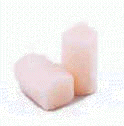
If you ask for earplugs in a pharmacy, the chances are that you will be offered one of two types. One is flesh-coloured wax and the other is foam (see below).
There are various makes of wax earplugs offering slightly different sizes and sometimes a fluffy coating, but for all practical purposes the differences are insignificant.
|
Wax earplugs: SUMMARY |
|
| noise reduction | Good |
| flexibility in the ear | Extremely poor |
| non-echoing | Fair |
| comfort | Fair once warm and inserted |
| portability | Good |
| appearance | Fair |
| wind pain | Not tested |
| watertight | Not tested but unlikely |
| stickiness | Does not significantly stick to hair once inserted |
| readiness for use | Extremely poor |
| availability | high street shops and the internet |
| price | Reasonable |
Wax earplugs certainly can keep out sound, and some manufacturers state their decibel rating.
I know women - yes they are all women - who are completely happy with wax earplugs for wearing in bed to protect against background noise or a partner's snoring. For the purpose of this review, I tried them while lying on a pillow, and they performed particularly well compared with other types of earplug (see below). Being inserted right into the ear, they didn't transmit a rubbing sound as I tossed and turned my head on the pillow.
At room temperature in the UK they are as hard as rocks. Consequently they cannot be inserted into ears without working them first between the fingers to soften them. They do soften, but by the time they do, the source of the noise may have passed. So wax earplugs are for medium to long term predictable noise, like aircraft noise when there are problems with flying. They are no use for a quick fix, like an oncoming police siren.
Reviews such as this, based on personal experience, may be incomplete. Also they are only as good as at the time of writing. As manufacturers are always improving their products, you may be able to add something. If so, please let me know.
Wax earplugs have another considerable disadvantage. Even once softened and in the ear, the slightest jaw movement, like talking or eating, dislodges them slightly, and even a tiny crack lets sound in. This means that wax earplugs are of negligible use against noise at events like large dinner parties when everyone is talking, eating and crashing cutlery around - and you are supposed to be moving your own jaw by eating too. The natural reaction is to press the earplugs in again every time they let in sound, but this causes pressure to build up behind them which after a while becomes uncomfortable, even painful.
Wax earplugs come in multi-packs and are relatively cheap. They are not nice to re-use, although some people certainly do reuse them. There are often much better alternatives - see below.
Foam earplugs
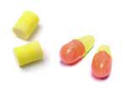
Foam earplugs are the second of the two main types of earplug that pharmacists tend to stock. They are often also available in airport shops. Specialist foam earplugs for specific purposes can be bought on the internet and in some retail outlets. They come in either plain or two-tone and are described as disposable.
An audiologist has asked me to point out that overuse of earplugs can lead to hypersensitivity. (He quoted the research publications of Kevin Munroe, Powel Jastreboff and Richard Salvi)
How good or bad foam earplugs are at reducing noise depends on the type of foam and the type of moulding. They can be useless or they can be very good indeed if inserted properly. Before insertion they need to be squeezed and rolled into a small 'rod'. Then the ear lobe must be pulled down slightly to straighten the ear canal. After insertion there is a short delay while the foam expands back and fits itself into the shape of the canal.
This property of expanding to fit the ear canal is a very big positive for foam earplugs because it makes them ideal for group activities where talking and eating is involved, ie where the shape of the ear canal is constantly changing.
Foam ear plugs come in multi-packs and are relatively cheap. Some manufacturers quote them as washable for re-use, but I once left a pair in a pocket which went into the wash. The earplugs emerged twice their normal size and the water could be wrung out of them. I dread to think what would happen if anyone should go swimming with them! I suppose much depends on the type of foam, but my strong recommendation is to keep foam earplugs well away from water.
|
Foam earplugs: SUMMARY |
|
| noise reduction | available at a range of specified decibel ratings |
| flexibility in the ear | Extremely good |
| non-echoing | Fairly good |
| comfort | Good, but latex or silicone allergy sufferers should look closely at the small print on the label |
| portability | Good |
| appearance | Fair |
| wind pain | Not tested |
| watertight | Do not allow near water |
| stickiness | Does not stick to hair |
| readiness for use | Poor |
| availability | Retail outlets and internet |
| price | Reasonable |
Specialist foam earplugs are available for specific purposes, mainly via the internet:
Noise reduction
Currently the highest noise reduction rating for foam earplugs seems to be 32 decibels (dB), but the range of frequencies over which this applies is not stated.
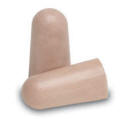
The 32dB solid foam earplug comes in several colours including flesh colour. It is by far my favourite for general use. The disadvantage of the delay while it expands to fit the ear canal does not worry me, because if I need an immediate response for, say, a fire engine siren, I just put my fingers in my ears.
These 32db flesh coloured foam earplugs are part of the Macks range, but they were my favourite for general use well before Macks sent me samples for this review. I keep a pair in all my bags and in the car, so that I am never without them.
I have commandeered all sorts of boxes and containers to hold them, and wish that earplug manufacturers would sell suitable containers for carrying single pairs of earplugs around. Single pairs are sold in flimsy plastic bags and bulk purchases in largish containers.
Foam earplugs for sleeping
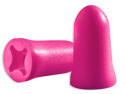 A
variation on the above are sold as comfortable for sleeping. This is
presumably because the they are slightly hollowed out with a hole up the
centre which collapses and expands according to whether or not one is
lying on it. The highest rating I have found is again 32dB, but that
brings into question the effect of the earplugs being thinner because of being hollowed out. I wore
some by mistake on a train journey and
found myself wondering what was the matter because they weren't keeping
down the train noise as much as usual.
A
variation on the above are sold as comfortable for sleeping. This is
presumably because the they are slightly hollowed out with a hole up the
centre which collapses and expands according to whether or not one is
lying on it. The highest rating I have found is again 32dB, but that
brings into question the effect of the earplugs being thinner because of being hollowed out. I wore
some by mistake on a train journey and
found myself wondering what was the matter because they weren't keeping
down the train noise as much as usual.
For the purpose of this review, I also tried lying on the earplug, but I found it painful because the hollow collapsing and expanding seemed to cause variations in pressure. Also the earplug rubbed against the pillow, transmitting sound. However, I must stress that my ears are particularly sensitive following my ear operation. For anyone with normal hearing, sleeping with someone who snores or where there is background noise, these earplugs must be worth trying.
Flat roll-up foam earplugs
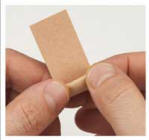
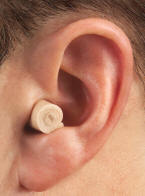 Roll-up
earplugs are
advertised as suitable for keeping in a wallet,
because they are flat. The idea is that one should never be without
them.
Roll-up
earplugs are
advertised as suitable for keeping in a wallet,
because they are flat. The idea is that one should never be without
them.
Their noise reduction rating is quoted as 21 dB.
I asked some men to try them
as my own ear canals were too small to take them, as were the ear canals
of the other women who tried them. (They are clearly targeted at men.) Most of the men had no trouble
inserting them but were unable to try them out in noisy
environments.
Fantasy foam ear plugs
Within obvious limits, manufacturers can make their foam earplugs in a variety of shapes. Some I came across which are also targeted at men are shaped like bullets and called ear ammo. In real terms, though, they are little different from standard foam earplugs, although slightly larger. They are rated at 30 dB.
Narrower foam earplugs for smaller ears
An audiologist has asked me to point out that overuse of earplugs can lead to hypersensitivity. (He quoted the research publications of Kevin Munroe, Powel Jastreboff and Richard Salvi)
I well know the somewhat strange feeling as a foam earplug expands inside one's ear, and this may suggest to some people that they would prefer a narrower version. However, although my own ear canals are on the small side, I have never felt the need for narrower foam earplugs. In fact I welcome the feeling of the foam expanding to fit my ear canal, as it is accompanied by a progressive lowering of the intrusive noise level. I never find it uncomfortable. That said, I did try the above 'ear ammo' earplugs for larger ears and did find them uncomfortable after a time, so there must be a place for the narrow earplugs for particularly small ears - including perhaps those of young teenagers.
Silicone putty earplugs
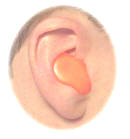
Silicone putty earplugs are said to be the best selling earplug in America, and judging by the adverts for them, I can understand why - because they look really neat and attractive in the ear. They come in a range of colours, which means that individuals who do not wish to draw attention to their use can choose the flesh coloured ones, while other individuals can colour co-ordinate as if they were earrings.
|
Silicone putty earplugs: SUMMARY |
|
| noise reduction | not stated |
| flexibility in the ear | n/a as used outside ear |
| non-echoing | depends on type of use |
| comfort | Feel about to fall-off Silicone allergy sufferers should look closely at the small print on the label |
| portability | Good |
| appearance | As good as it gets |
| wind pain | Not tested |
| watertight | n/a |
| stickiness | Sticks and pulls hair |
| readiness for use | Good |
| availability | Mainly internet |
| price | Reasonable |
The instructions say that silicone putty earplugs should be placed over the ear canal but, unlike wax and foam earplugs, specifically not inside it. This is straightforward to do because the silicone is so soft. However to get the appearance in the picture, they need to be separated into smaller lumps - which is again straightforward to do.
Used as instructed, ie placed over the ear canal rather than in it, the silicone putty sticks to long hair and quickly loses good contact as one moves one's jaw. The ensuing chinks let through sound.
A version of these earplugs is also publicised as soft for sleeping. However, as one changes position on the pillow, long hair sticks on it and the rubbing noise of the pillow is transmitted into the ear. When I tried it, I removed it almost immediately, but am confident that if I hadn't, it would have come out by itself during the night.
I suspect that silicone putty earplugs would be significantly more effective if they were smaller and could be inserted right into the ear canal, but the manufacturers' instructions clearly state otherwise, probably because of the difficulty of removing them without them falling apart and leaving bits inside the ear. More guidance would be useful.
Flange earplugs
A range of flange-type earplugs are advertised, some with a decibel rating describing how much sound they reduce.
I have bought several types of flange earplugs and have found that by far the most important thing is to get the size right. If the flange is too large it buckles in the ear which means that it not only lets in sound, but it also clicks annoyingly as one moves one's head. For me, the small size version works very well., and in this respect flange earplugs seem on a par with the best of the foam.
Although flange earplugs with the maximum decibel rating are so effective at reducing sound, they are more expensive than foam ones. So they are not worth the money if reducing noise is the only consideration. However there are other considerations:
Cord connections for flange earplugs
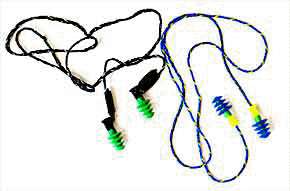
Some flange-type earplugs come with a cord connecting them. This keeps the earplugs together when they are removed from the ears and keeps them in readiness should the need for them arise. There are detachable and non-detachable cord versions.
The cord is a mixed blessing. As the earplugs are lightweight, they don't stay securely hanging over the shoulders when not in use (as do glasses on a chain). I have lost a couple of pairs this way. Also the sound of the cord rubbing against clothes is carried along the cord to the ears and can be extremely irritating.
Flange earplugs for listening to music
Some flange type earplugs are sold specifically for listening to music. As my ears don't cope well with music. I asked others to check out the Macks version rated at 21dB.
All reports were that the earplugs were very good indeed at reducing the volume of music while also maintaining quality.
Other comments were: The cord attaching the earplugs had to be removed or draped over the head to avoid the noise of it rubbing against clothes being transmitted into the ears; the earplugs caused one's own voice to echo inside one's head when one tried to talk - not that that would be an issue while listening to music, and not that everyone seemed equally disconcerted about it; the earplugs are best inserted with a screwing action; the further in they are, the more effective they become; but when in as far as they can go, one can hear one's own pulse or heartbeat which is somewhat distracting. (I found this difficult to believe, so tested it, and it was true!)
|
Flange earplugs: SUMMARY |
|
| noise reduction | depends on type |
| flexibility in the ear | Good if size is right |
| non-echoing | Own voice echoes |
| comfort | Good |
| portability | Good |
| appearance | Fair with cord removed |
| wind pain | Not tested |
| watertight | Yes for the watertight version |
| stickiness | Does not stick to hair |
| readiness for use | Good |
| availability | Mainly via internet |
| price | More expensive than foam |
Flange earplugs for swimming

Some flange type earplugs are sold as watertight, and, according to the swimmers in my family, they work well. One family member is particularly pleased with them because she used to get ear ache and hear badly for a few days after swimming.
However, be warned: groups swimming for pleasure often want to talk to one another. So the earplugs get repeatedly inserted and taken out; they slip out of fingers and are lost in the water.
Flange earplugs for flying
I have seen flange earplugs sold for specifically flying. This is unfortunate to say the least. Pain in flying is invariably more due to pressure differences inside and outside the ear than to noise. Whatever the earplugs used against the noise, they must be accompanied by techniques to equalise pressure, as described on the page about flying. Otherwise earplugs cause more damage than no earplugs because they work against the body's attempts to equalise pressure naturally. Anyone who wants to reduce noise when flying should first try out a range of earplugs in other noisy environments and choose according.
Ear defenders
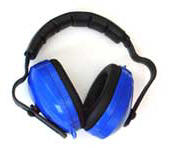 There
is a lot in favour of ear defenders, but of course there is the obvious
disadvantage that they are conspicuous. They are hardly an attractive
dress accessory and wearing them in normal environments understandably
attracts stares.
There
is a lot in favour of ear defenders, but of course there is the obvious
disadvantage that they are conspicuous. They are hardly an attractive
dress accessory and wearing them in normal environments understandably
attracts stares.
As people hear through the bones and tissues of their heads as well as through their ears, the ideal ear protection protects the area round the ears as well as the ear canals.
Another positive is that ear defenders can, a moment's notice, be pulled to one side for listening to a conversation or equalising air pressure when there are problems with flying.
Ear defenders also last many years without needing to be replaced.
Ear defenders are comfortable to wear over reasonably long periods, although being a spring-fit, they can feel tight eventually.
Ear defenders do, of course, have the obvious disadvantage that they are conspicuous. They attract stares when worn in situations which most people do not regard as noisy. Also wearers can appear rude in social situations as there is the assumption that they are withdrawing from the group and listening to their own music.
Not all ear defenders cut out sound equally well and some specialise on particular types of sound, such as the noise of machinery. The sorts available in DIY stores are general purpose, but specialist ones bought over the internet are more likely to suit particular needs.
Ear defenders are relatively expensive.
|
Ear defenders: SUMMARY |
|
| noise reduction | Depends on type. Can be extremely good |
| flexibility in the ear | n/a - worn outside ears |
| non-echoing | Good |
| comfort | Good. Spring can feel tight after a time |
| portability | All types bulky - folding ones less so |
| appearance | Conspicuous |
| wind pain | Good |
| watertight | No |
| stickiness | Does not stick to hair |
| readiness for use | Good |
| availability | Mainly via internet |
| price | Relatively expensive |
Folding ear defenders (available on the internet)
Folding ear defenders have all the advantages of regular ear defenders, and are small enough to be popped into a regular bag and carried around. A disadvantage is that the spring band is tighter than on regular ear defenders which gives me a pain across my temples after a time.
Nevertheless folding ear defenders are part of my standard armoury at, for example, children's pantomimes where the noise level seems to increase each year.
They are available over the internet from specialist suppliers.
Mufflers
Mufflers are mainly for warmth and fashion. They are good against wind pain but of little use against noise unless they have been specially manufactured for the purpose.
Noise cancelling headphones
Noise cancelling headphones can generate sound electronically which is said to cancel out outside noise. Such headphones are particularly recommended on flights to cancel out aircraft noise, and they are reported to be particularly good at this, probably because the noise is so uniform. My own experience of them is extremely limited, so may not be representative, but I did try a pair on a car journey to test its effect on road and engine noise. However I found that my favourite foam earplugs cut out the noise more effectively and of course more cheaply - but that was a journey along land where the differences in air pressure on flights were not an issue.
Noise cancelling headphones are of course more expensive than earplugs, but they do have the advantages that they enable the wearer to listen to music, etc, while limiting intrusive outside noise, and they can be slipped aside momentarily to equalise pressure during flights.
Automatic volume limiters
A small device on the market can be plugged into earphones to reduce the maximum volume that most portable music players deliver.
I was reluctant to try it myself because my ears are so sensitive, but there is no shortage of teenagers with music players in my family and they obliged. Their reports were that the device certainly did cut down the sound volume, but that it was simpler to use the volume control on the music player.
It is unclear whether the device limits excessively loud sound while keeping other sounds at the same level or whether it merely makes all sound quieter. In view of the lack of clarity it is probably the latter, which means that it really is simpler to use the volume control on the music player.
What anyone with sensitive hearing really wants is a device for use with phones and internet video to keep speech at its normal level while limiting sudden penetrating sound such as a child screaming or static noise.
It would help for the manufacturers to make the specifications of their volume limiters clearer and, if necessary, to produce alternative versions.
Cotton-wool earplugs
Cotton-wool is included in this review simply because so many people seem to use it. There are however much more effective products on the market for almost all types of need.
The best thing to be said about cotton-wool is that it can serve in an emergency against ear ache in wind.
Fingers in ears
For sudden sounds like and an approaching fire engine or a child's scream, there seems to be no substitute for pushing fingers into ears - unless of course one wears ear protection all the time and doesn't mind hearing nothing.
More on problems with sensitive hearing
Some sounds are extremely painful
How to help someone with painful hearing
Protection against noise
Review of earplugs, ear defenders and other hearing protection
Disclaimer: The information on this site is for a lay audience and I cannot be responsible for errors or omissions. The views, strategies, advice and suggestions etc are based on my personal experience and are not necessarily appropriate for anyone else. They should, hopefully, stimulate individuals to develop their own strategies.